TEPCO is using a robot to traverse the Unit #1 reactor looking for leaks. It has found its first leak, close to the lower part of the Reactor 1
containment vessel at the wrecked Fukushima Daiichi on Wednesday.
The camera spotted two leaks from the reactor into the containment building.
Radiation levels near the leaks were measured at 0.9 to 1.8 sieverts an hour - whereas a typical release of radiation
is generally accepted to be 1 millisievert a year. In other words the radiation level is off the charts compared to normal radiation releases. However that radiation release is occurring inside the containment building.
However it's demonstrating that the containment vessel is cracked - which is to be expected.
Source: http://www3.nhk.or.jp/news/html/20131114/k10013066251000.html
Source: http://rt.com/news/fukushima-robot-detect-radiation-729/
Thursday, November 14, 2013

Monday, November 11, 2013
Fukushima water storage tanks flawed, workers say
According to quotes from workers who had built the water storage tanks at the Fukushima plant - the storage tank construction was slipshod. They hired workers who weren't construction workers - they hired people like bus drivers.
“I must say our tank assembly was slipshod work. I’m sure that’s why tanks are leaking already,” Uechi, 48, told The Associated Press from his hometown on Okinawa. “I feel nervous every time an earthquake shakes the area.”
“We were in an emergency and just had to build as many tanks as quickly as possible, and their quality is at bare minimum,” said Teruaki Kobayashi, an official in charge of facility control for the plant operator, Tokyo Electric Power Co.
Leaks and other flaws found in several tanks have raised concerns about further and more damaging failures, particularly if another big earthquake, tsunami or typhoon hits. The plant suffered a triple meltdown after Japan’s devastating 2011 earthquake and tsunami.
The plant has more than 1,000 tanks and other containers storing 370,000 tons of partially treated but still highly contaminated water. About one-third of the containers are easy-to-assemble steel tanks with rubber-sponge seams tightened with bolts; they were always considered a stopgap measure. The other tanks are considered sturdier.
http://www.japantoday.com/category/national/view/fukushima-water-storage-tanks-flawed-workers-say
“I must say our tank assembly was slipshod work. I’m sure that’s why tanks are leaking already,” Uechi, 48, told The Associated Press from his hometown on Okinawa. “I feel nervous every time an earthquake shakes the area.”
“We were in an emergency and just had to build as many tanks as quickly as possible, and their quality is at bare minimum,” said Teruaki Kobayashi, an official in charge of facility control for the plant operator, Tokyo Electric Power Co.
Leaks and other flaws found in several tanks have raised concerns about further and more damaging failures, particularly if another big earthquake, tsunami or typhoon hits. The plant suffered a triple meltdown after Japan’s devastating 2011 earthquake and tsunami.
The plant has more than 1,000 tanks and other containers storing 370,000 tons of partially treated but still highly contaminated water. About one-third of the containers are easy-to-assemble steel tanks with rubber-sponge seams tightened with bolts; they were always considered a stopgap measure. The other tanks are considered sturdier.
http://www.japantoday.com/category/national/view/fukushima-water-storage-tanks-flawed-workers-say
Thursday, November 7, 2013
Big quake near Fukushima would ‘decimate Japan, lead to US West Coast evacuation’
Speaking at a symposium on water ecology at the University of
Alberta in Canada, prominent Japanese-Canadian scientist David
Suzuki said that the Japanese government had been “lying
through its teeth” about the true extent of the 2011
Fukushima nuclear disaster.
“Fukushima is the most terrifying situation that I can imagine,” Suzuki said, adding that another earthquake could trigger a potentially catastrophic, nuclear disaster.
“The fourth [reactor] has been so badly damaged that the fear is if there’s another earthquake of a 7 or above then that building will go and all hell breaks loose,” he said, adding that the chances of an earthquake measuring 7 or above in Japan over the next three years were over 95 percent.
“If the fourth [reactor] goes under an earthquake and those rods are exposed, then it’s bye, bye, Japan and everybody on the west coast of North America should be evacuated. And if that isn’t terrifying, I don’t know what is,” Suzuki said.
“Fukushima is the most terrifying situation that I can imagine,” Suzuki said, adding that another earthquake could trigger a potentially catastrophic, nuclear disaster.
“The fourth [reactor] has been so badly damaged that the fear is if there’s another earthquake of a 7 or above then that building will go and all hell breaks loose,” he said, adding that the chances of an earthquake measuring 7 or above in Japan over the next three years were over 95 percent.
“If the fourth [reactor] goes under an earthquake and those rods are exposed, then it’s bye, bye, Japan and everybody on the west coast of North America should be evacuated. And if that isn’t terrifying, I don’t know what is,” Suzuki said.
Japan to begin removal of fuel rods from Fukushima plant
TEPCO's plan for moving fuel rods from unit #4 was approved during the week of November 7.
The removal of fuel is part of regular work at any nuclear power plant, but "conditions are different from normal because of the disaster," said company spokeswoman Mayumi Yoshida.
Extraction is expected to begin mid-November.
The article contains some scary statements from Scientists and Activists. However some of these statements come from people who have a vested interest in making it look more scary than it actually is. While those statements could be valid, their vested interest has to make us ponder whether their statements are skewed or not.
“Handling spent fuels involves huge risks," said Shunichi Tanaka, chairman of the Nuclear Regulation Authority. "It would be a disaster if radioactive materials come out of the metal rods during the work.”
"This is the first practical milestone for the project," said Hiroshi Miyano, a nuclear systems expert and visiting professor at Hosei University in Tokyo.
"Any trouble in this operation will considerably affect the timetable for the entire project," he said to AFP. "This is an operation TEPCO cannot afford to bungle."
Christina Consolo, the founder and host of Nuked Radio ... “The worst-case scenario is that there’s a nuclear chain reaction, a criticality in the pool during this procedure and it can’t be stopped,” she said.
Kevin Kamps, a nuclear waste specialist from the organization Beyond Nuclear, believes it is “absurd” that TEPCO is in charge of this globally significant extraction operation ...
“If something goes wrong this could be a global catastrophe that dwarfs what has happened in Fukushima Daiichi thus far,” Kamps told RT. “Tokyo Electric has shown its true colors time and time again, its incompetence, its dishonesty, so it’s very frightening that TEPCO is in charge of this.”
Arnold Gunderson, a nuclear power expert, explained to RT that what they will attempt to do at Fukushima has never been done before but it has to be done ... “There is more radioactivity in that fuel pool than in all the bombs than in all the bombs that were fired in above ground testing. So we have the equivalent of 700 nuclear bombs worth of material in that fuel pool. These [the fuel rods] are not going to pull out easily and the fear is, is that they might snap and release the radiation that’s inside them,” he told RT.

Source: http://rt.com/news/fukushima-fuel-rod-removal-365/
The removal of fuel is part of regular work at any nuclear power plant, but "conditions are different from normal because of the disaster," said company spokeswoman Mayumi Yoshida.
Extraction is expected to begin mid-November.
The article contains some scary statements from Scientists and Activists. However some of these statements come from people who have a vested interest in making it look more scary than it actually is. While those statements could be valid, their vested interest has to make us ponder whether their statements are skewed or not.
“Handling spent fuels involves huge risks," said Shunichi Tanaka, chairman of the Nuclear Regulation Authority. "It would be a disaster if radioactive materials come out of the metal rods during the work.”
"This is the first practical milestone for the project," said Hiroshi Miyano, a nuclear systems expert and visiting professor at Hosei University in Tokyo.
"Any trouble in this operation will considerably affect the timetable for the entire project," he said to AFP. "This is an operation TEPCO cannot afford to bungle."
Christina Consolo, the founder and host of Nuked Radio ... “The worst-case scenario is that there’s a nuclear chain reaction, a criticality in the pool during this procedure and it can’t be stopped,” she said.
Kevin Kamps, a nuclear waste specialist from the organization Beyond Nuclear, believes it is “absurd” that TEPCO is in charge of this globally significant extraction operation ...
“If something goes wrong this could be a global catastrophe that dwarfs what has happened in Fukushima Daiichi thus far,” Kamps told RT. “Tokyo Electric has shown its true colors time and time again, its incompetence, its dishonesty, so it’s very frightening that TEPCO is in charge of this.”
Arnold Gunderson, a nuclear power expert, explained to RT that what they will attempt to do at Fukushima has never been done before but it has to be done ... “There is more radioactivity in that fuel pool than in all the bombs than in all the bombs that were fired in above ground testing. So we have the equivalent of 700 nuclear bombs worth of material in that fuel pool. These [the fuel rods] are not going to pull out easily and the fear is, is that they might snap and release the radiation that’s inside them,” he told RT.
Source: http://rt.com/news/fukushima-fuel-rod-removal-365/
Tuesday, November 5, 2013
1 million tons of Fukushima debris floating near US West Coast? -- NOT RADIOACTIVE
There's been reports that a large "island" of debris from the Fukushima Tsunami are floating in the Ocean and about to hit the US West Coast.
The word "island" is a bit of a misnomer because it's just a large cluster of debris, rather than a solid mass.
It's also clear that radiation from this debris is negligible. On its website, the NOAA says, “Radiation experts agree that it is highly unlikely that any tsunami-generated marine debris will hold harmful levels of radiation from the Fukushima nuclear emergency.”
Independent groups like the 5 Gyres Institute, which tracks pollution at sea, have echoed the NOAA’s findings, saying that radiation readings have been “inconsequential.” Even the release of radioactive water from the Fukushima nuclear reactor shouldn't be a grave concern, since scientists say it will be diluted to the point of being harmless by the time it reaches American shores in 2014.
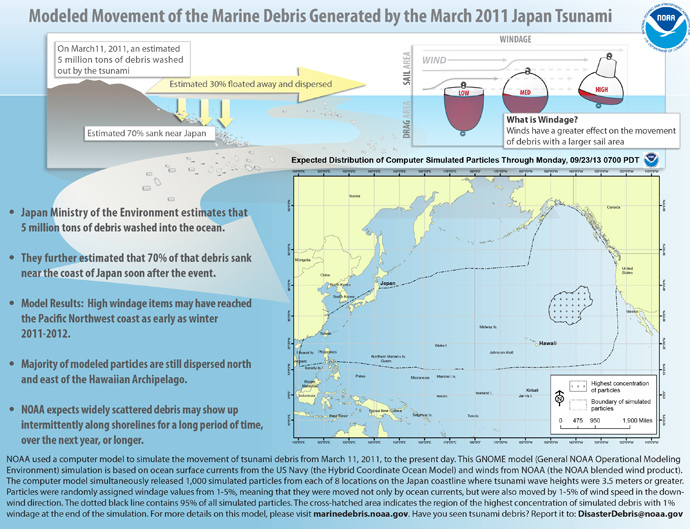
The word "island" is a bit of a misnomer because it's just a large cluster of debris, rather than a solid mass.
It's also clear that radiation from this debris is negligible. On its website, the NOAA says, “Radiation experts agree that it is highly unlikely that any tsunami-generated marine debris will hold harmful levels of radiation from the Fukushima nuclear emergency.”
Independent groups like the 5 Gyres Institute, which tracks pollution at sea, have echoed the NOAA’s findings, saying that radiation readings have been “inconsequential.” Even the release of radioactive water from the Fukushima nuclear reactor shouldn't be a grave concern, since scientists say it will be diluted to the point of being harmless by the time it reaches American shores in 2014.
Friday, November 1, 2013
Multi-decadal projections of surface and interior pathways of the Fukushima Cesium-137 radioactive plume
Highlights
- Cs-137 plume strongly diluted by July 2011, reaches American coast by 2014.
- Mode water formation and persistent upwelling affect Cs-137 concentrations.
- Cs-137 enters the deep ocean and exits the North Pacific in the next 30 years.
- Sensitivity to uncertainties in the source function and to interannual variability.
Abstract
Following
the March 2011 Fukushima disaster, large amounts of water contaminated
with radionuclides, including Cesium-137, were released into the Pacific
Ocean. With a half-life of 30.1 years, Cs-137 has the potential to
travel large distances within the ocean. Using an ensemble of regional
eddy-resolving simulations, this study investigates the long-term
ventilation pathways of the leaked Cs-137 in the North Pacific Ocean.
The simulations suggest that the contaminated plume would have been
rapidly diluted below 10,000 Bq/m3 by the energetic Kuroshio Current and Kurushio Extension by July 2011. Based on our source function of 22 Bq/m3, which sits at the upper range of the published estimates, waters with Cs-137 concentrations >10 Bq/m3
are projected to reach the northwestern American coast and the Hawaiian
archipelago by early 2014. Driven by quasi-zonal oceanic jets, shelf
waters north of 45°N experience Cs-137 levels of 10–30 Bq/m3 between 2014 and 2020, while the Californian coast is projected to see lower concentrations (10–20 Bq/m3)
slightly later (2016–2025). This late but prolonged exposure is related
to subsurface pathways of mode waters, where Cs-137 is subducted toward
the subtropics before being upwelled from deeper sources along the
southern Californian coast. The model suggests that Fukushima-derived
Cs-137 will penetrate the interior ocean and spread to other oceanic
basins over the next two decades and beyond. The sensitivity of our
results to uncertainties in the source function and to inter-annual to
multi-decadal variability is discussed.
A Statement from U.S. Secretary of Energy Ernest Moniz Regarding Fukushima
A Dept of Energy press release from - http://energy.gov/articles/statement-us-secretary-energy-ernest-moniz-regarding-fukushima
“On Friday, I made my first visit to the Fukushima Daiichi Nuclear Power Station. It is stunning that one can see firsthand the destructive force of the tsunami even more than two and a half years after the tragic events. The words of President Obama following the incident still hold true today: ‘The Japanese people are not alone in this time of great trial and sorrow. Across the Pacific, they will find a hand of support extended from the United States as they get back on their feet.’ My colleagues from the Department of Energy and I are grateful for the cooperation and openness of our host, TEPCO President Hirose, and his dedicated staff. They face a daunting task in the cleanup and decommissioning of Fukushima Daiichi, one that will take decades and is being carried out under very challenging conditions. The TEPCO workforce is facing unprecedented challenges and is clearly focused on devising and implementing solutions.
“From the beginning, the United States has worked to support the Government of Japan in the immediate response efforts and in recovery, decommissioning, and cleanup activities. Within days of the accident, the Department of Energy sent a team of 34 experts and more than 17,000 pounds of equipment in support of efforts to manage the crisis. I was able to witness firsthand the continuing partnership between TEPCO and U.S. agencies and companies.
“The DOE, our national labs, and U.S. companies will continue to offer our experience and capabilities to assist the Japanese government and TEPCO, especially with regard to water contamination issues. On Thursday, we were able to meet with Prime Minister Abe, METI Minister Motegi, and other senior members of the Japanese government. Their commitment to advancing the Convention on Supplementing Compensation of Nuclear Liability is much appreciated, since this will facilitate the further engagement of U.S. and other companies in Fukushima cleanup.
“We also witnessed the progress being made on spent fuel removal activities in parallel with the water challenges. It appears that spent nuclear fuel will begin to be removed from Unit 4 as scheduled in mid-November. This will be significant milestone for TEPCO and the Japanese Government and in the process of decommissioning the site.
“As Japan continues to chart its sovereign path forward on the cleanup at the Fukushima site and works to determine the future of their energy economy, the United States stands ready to continue assisting our partners in this daunting yet indispensable task. The United States and Japan created the Bilateral Commission to strengthen our strategic and practical engagement on civil nuclear R&D, Fukushima cleanup, emergency response, nuclear safety regulatory matters, and nuclear security and nonproliferation, and we look forward to the commission meeting next week in Washington, D.C.”
“On Friday, I made my first visit to the Fukushima Daiichi Nuclear Power Station. It is stunning that one can see firsthand the destructive force of the tsunami even more than two and a half years after the tragic events. The words of President Obama following the incident still hold true today: ‘The Japanese people are not alone in this time of great trial and sorrow. Across the Pacific, they will find a hand of support extended from the United States as they get back on their feet.’ My colleagues from the Department of Energy and I are grateful for the cooperation and openness of our host, TEPCO President Hirose, and his dedicated staff. They face a daunting task in the cleanup and decommissioning of Fukushima Daiichi, one that will take decades and is being carried out under very challenging conditions. The TEPCO workforce is facing unprecedented challenges and is clearly focused on devising and implementing solutions.
“From the beginning, the United States has worked to support the Government of Japan in the immediate response efforts and in recovery, decommissioning, and cleanup activities. Within days of the accident, the Department of Energy sent a team of 34 experts and more than 17,000 pounds of equipment in support of efforts to manage the crisis. I was able to witness firsthand the continuing partnership between TEPCO and U.S. agencies and companies.
“The DOE, our national labs, and U.S. companies will continue to offer our experience and capabilities to assist the Japanese government and TEPCO, especially with regard to water contamination issues. On Thursday, we were able to meet with Prime Minister Abe, METI Minister Motegi, and other senior members of the Japanese government. Their commitment to advancing the Convention on Supplementing Compensation of Nuclear Liability is much appreciated, since this will facilitate the further engagement of U.S. and other companies in Fukushima cleanup.
“We also witnessed the progress being made on spent fuel removal activities in parallel with the water challenges. It appears that spent nuclear fuel will begin to be removed from Unit 4 as scheduled in mid-November. This will be significant milestone for TEPCO and the Japanese Government and in the process of decommissioning the site.
“As Japan continues to chart its sovereign path forward on the cleanup at the Fukushima site and works to determine the future of their energy economy, the United States stands ready to continue assisting our partners in this daunting yet indispensable task. The United States and Japan created the Bilateral Commission to strengthen our strategic and practical engagement on civil nuclear R&D, Fukushima cleanup, emergency response, nuclear safety regulatory matters, and nuclear security and nonproliferation, and we look forward to the commission meeting next week in Washington, D.C.”
Subscribe to:
Posts (Atom)