Tuesday, November 5, 2013

1 million tons of Fukushima debris floating near US West Coast? -- NOT RADIOACTIVE

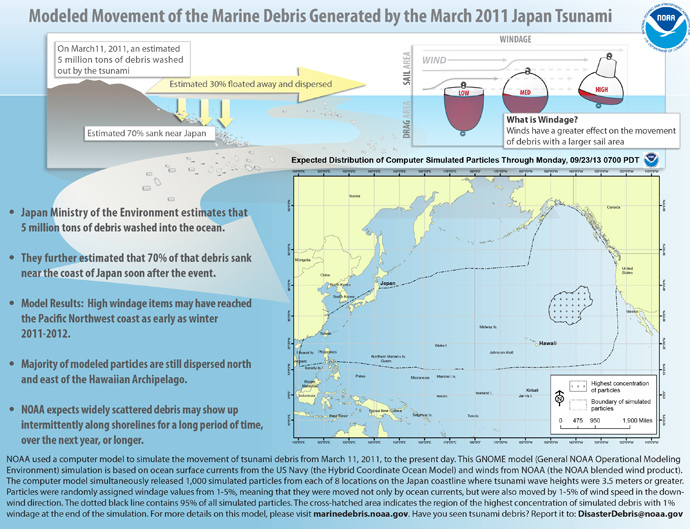
There's been reports that a large "island" of debris from the Fukushima Tsunami are floating in the Ocean and about to hit the US West Coast.

The word "island" is a bit of a misnomer because it's just a large cluster of debris, rather than a solid mass.

It's also clear that radiation from this debris is negligible.  On its website, the NOAA says, “Radiation experts agree that it is highly unlikely that any tsunami-generated marine debris will hold harmful levels of radiation from the Fukushima nuclear emergency.”

Independent groups like the 5 Gyres Institute, which tracks pollution at sea, have echoed the NOAA’s findings, saying that radiation readings have been “inconsequential.” Even the release of radioactive water from the Fukushima nuclear reactor shouldn't be a grave concern, since scientists say it will be diluted to the point of being harmless by the time it reaches American shores in 2014.

Friday, November 1, 2013

Multi-decadal projections of surface and interior pathways of the Fukushima Cesium-137 radioactive plume

Highlights

  • Cs-137 plume strongly diluted by July 2011, reaches American coast by 2014.
  • Mode water formation and persistent upwelling affect Cs-137 concentrations.
  • Cs-137 enters the deep ocean and exits the North Pacific in the next 30 years.
  • Sensitivity to uncertainties in the source function and to interannual variability.

Abstract

Following the March 2011 Fukushima disaster, large amounts of water contaminated with radionuclides, including Cesium-137, were released into the Pacific Ocean. With a half-life of 30.1 years, Cs-137 has the potential to travel large distances within the ocean. Using an ensemble of regional eddy-resolving simulations, this study investigates the long-term ventilation pathways of the leaked Cs-137 in the North Pacific Ocean. The simulations suggest that the contaminated plume would have been rapidly diluted below 10,000 Bq/m3 by the energetic Kuroshio Current and Kurushio Extension by July 2011. Based on our source function of 22 Bq/m3, which sits at the upper range of the published estimates, waters with Cs-137 concentrations >10 Bq/m3 are projected to reach the northwestern American coast and the Hawaiian archipelago by early 2014. Driven by quasi-zonal oceanic jets, shelf waters north of 45°N experience Cs-137 levels of 10–30 Bq/m3 between 2014 and 2020, while the Californian coast is projected to see lower concentrations (10–20 Bq/m3) slightly later (2016–2025). This late but prolonged exposure is related to subsurface pathways of mode waters, where Cs-137 is subducted toward the subtropics before being upwelled from deeper sources along the southern Californian coast. The model suggests that Fukushima-derived Cs-137 will penetrate the interior ocean and spread to other oceanic basins over the next two decades and beyond. The sensitivity of our results to uncertainties in the source function and to inter-annual to multi-decadal variability is discussed.


A Statement from U.S. Secretary of Energy Ernest Moniz Regarding Fukushima

A Dept of Energy press release from - http://energy.gov/articles/statement-us-secretary-energy-ernest-moniz-regarding-fukushima

“On Friday, I made my first visit to the Fukushima Daiichi Nuclear Power Station. It is stunning that one can see firsthand the destructive force of the tsunami even more than two and a half years after the tragic events.  The words of President Obama following the incident still hold true today: ‘The Japanese people are not alone in this time of great trial and sorrow. Across the Pacific, they will find a hand of support extended from the United States as they get back on their feet.’ My colleagues from the Department of Energy and I are grateful for the cooperation and openness of our host, TEPCO President Hirose, and his dedicated staff. They face a daunting task in the cleanup and decommissioning of Fukushima Daiichi, one that will take decades and is being carried out under very challenging conditions. The TEPCO workforce is facing unprecedented challenges and is clearly focused on devising and implementing solutions.

“From the beginning, the United States has worked to support the Government of Japan in the immediate response efforts and in recovery, decommissioning, and cleanup activities. Within days of the accident, the Department of Energy sent a team of 34 experts and more than 17,000 pounds of equipment in support of efforts to manage the crisis. I was able to witness firsthand the continuing partnership between TEPCO and U.S. agencies and companies.

“The DOE, our national labs, and U.S. companies will continue to offer our experience and capabilities to assist the Japanese government and TEPCO, especially with regard to water contamination issues.  On Thursday, we were able to meet with Prime Minister Abe, METI Minister Motegi, and other senior members of the Japanese government. Their commitment to advancing the Convention on Supplementing Compensation of Nuclear Liability is much appreciated, since this will facilitate the further engagement of U.S. and other companies in Fukushima cleanup.

“We also witnessed the progress being made on spent fuel removal activities in parallel with the water challenges. It appears that spent nuclear fuel will begin to be removed from Unit 4 as scheduled in mid-November. This will be significant milestone for TEPCO and the Japanese Government and in the process of decommissioning the site.

“As Japan continues to chart its sovereign path forward on the cleanup at the Fukushima site and works to determine the future of their energy economy, the United States stands ready to continue assisting our partners in this daunting yet indispensable task. The United States and Japan created the Bilateral Commission to strengthen our strategic and practical engagement on civil nuclear R&D, Fukushima cleanup, emergency response, nuclear safety regulatory matters, and nuclear security and nonproliferation, and we look forward to the commission meeting next week in Washington, D.C.”
Thursday, October 31, 2013

Fukushima Daiichi operator should not handle shutdown, says governing party

TEPCO is about to begin moving nuclear rods from one of the damaged reactor units into dry cask storage.  However, Japan's governing Party suggests that TEPCO should be stripped of responsibility for decommissioning the Fukushima power plant complex.  

Instead a proposal by the Liberal Democratic party (LDP) would move decommissioning responsibilities to a unit that is financially independent of TEPCO.

TEPCO is expected to begin removing 1,300 spent fuel assemblies from the remains of the reactor No 4 building towards the middle of November 2013.
Some nuclear experts have warned that even a slight mishap involving the fuel rods could result in huge releases of radiation into the air and sea.
Shunichi Tanaka, the head of Japan's nuclear regulation authority, warned that the work would be more hazardous than usual because of debris that fell into the reactors storage pool during hydrogen explosions in March 2011.

"It's a totally different operation than removing normal fuel rods from a spent fuel pool," Tanaka said. "They need to be handled extremely carefully and closely monitored. You should never rush or force them out, or they may break. I'm much more worried about this than I am about contaminated water."
They'll be using a remote controlled crane to move damaged fuel assemblies one-by-one, putting them in dry casks, before putting them into a pool for long term storage and cool-down.

TEPCO claims it'll be fine with no exposure to workers.

http://www.theguardian.com/environment/2013/oct/31/japan-fukushima-daiichi-decommissioning-tepco

Tuesday, October 22, 2013

Ten Years of Fukushima Radiation Crossing the Pacific Ocean

Looks at what the Pacific Ocean will be like after 10 years of radioactive water releases into the Ocean.  In the conclusion the person writes that their personal decision to stop eating fish from the ocean may be unfounded, because it looks like the relative amount of toxicity will be small.  But we don't know enough about the effects of bio-accumulation will be and whether that will result in ocean-caught fish that's too radioactive to eat.  What we do know is that every inch of the Pacific Ocean will become contaminated over time.

http://climateviewer.com/2013/10/22/ten-years-of-fukushima-radiation-crossing-the-pacific-ocean/

Monday, October 7, 2013

Report raises fresh concerns about radiation levels in Japanese fish

The Japanese Fisheries Agency has been testing the radiation in fish caught in its waters since March 2011. On average, fish in the 33,000 tests had 18 becquerels per kilo of radioactive cesium – well below Health Canada’s ceiling of 1,000 becquerels per kilo for cesium and even Japan's ceiling of 100 becquerels.
 
Some fish samples tested to date have had very high levels of radiation: one sea bass sample collected in July, for example, had 1,000 becquerels per kilogram of cesium.

While Canadians are exposed to radiation every day from the sun and the environment, Edwards notes that radioactive cesium doesn't exist in nature at all and it's not known if there is any safe level.


http://canadaam.ctvnews.ca/report-raises-fresh-concerns-about-radiation-levels-in-japanese-fish-1.1486514

Thursday, October 3, 2013

Japan's Fukushima nuclear plant operator says another tank leaked toxic water


(Reuters) - The operator of Japan's crippled Fukushima nuclear plant said on Thursday another tank holding highly contaminated water overflowed, probably sending the liquid into the Pacific Ocean, in the second such breach in less than two months.

Tepco said the water that leaked contained 200,000 becquerels per liter of beta-emitting radioactive isotopes, including strontium 90. The legal limit for strontium 90 is 30 becquerels per liter.

About 430 liters (113 gallons) of water spilled over a period of as much as 12 hours after a worker misjudged how much could be held by the tank, which is tilting because of an uneven location, Tepco spokesman Masayuki Ono told reporters.

Source: http://www.reuters.com/article/2013/10/03/us-japan-fukushima-water-idUSBRE99200R20131003